St Oswald's CofE Academy "let all that you do be done in love"
Year 2 Class 2026/27
Who's who?
Mrs Myers - Class Teacher
Miss Pearson - Learning Support Assistant
Welcome to our Year 2 class page.
Here is some information about the Year 2 Curriculum for the Autumn Term:
Reading - Children should be reading regularly to an adult at home - a minimum of 3 times per week. Reading records are checked every Thursday and the number of times your child has read is noted down. Reading certificates and gold coins are awarded after every 30th log in their record.
PE - PE lessons will take place every Monday afternoon. Children should come to school wearing their full PE kit (navy/black joggers or shorts, house colour/white t-shirt, and dark jogging top or blue school jumper).
Forest School – Year 2 will begin their Forest School session during the Autumn Term on Wednesday afternoons. Please could children bring in waterproof clothing and wellington boots/old trainers for children to wear during these sessions.
Autumn Term Learning
MATHS
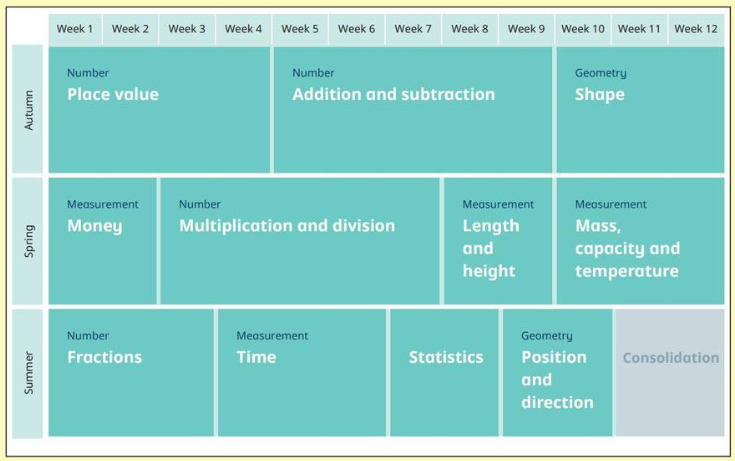
In Year 2 we plan and teach using the White Rose scheme of work. This scheme of learning is designed to support a mastery approach to teaching and learning and is consistent with the aims and objectives of the National Curriculum. The children have opportunities to build competency through concrete, pictorial and abstract approaches. The children have opportunities to revisit and consolidate prior learning and build upon this, using strategies to solve problems and mathematical language to explain our reasoning.
This term we are focusing on Place Value, Addition and Subtraction and Shape.
https://whiterosemaths.com/
Please find below a range of resources to support your child in maths:
Times Tables Rock Stars – Times Tables Rock Stars (ttrockstars.com)
Numbots Game
Numberblocks - BBC iPlayer
Hit the Button - Quick fire maths practise for 6-11 year olds (topmarks.co.uk)
Daily 10 - Mental Maths Challenge - Topmarks
1-Minute Maths App | White Rose Maths
ENGLISH
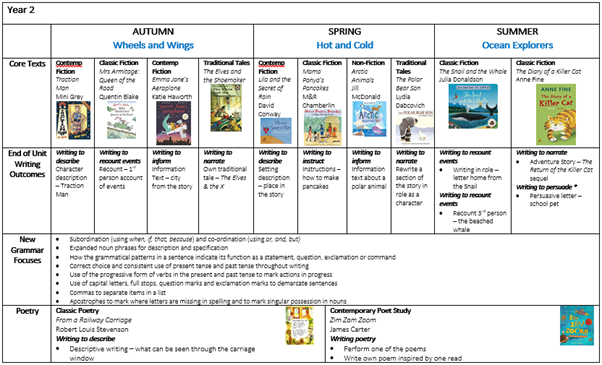
In Year 2, our literacy is taught through a key text which provides a stimulus for our literacy lessons. Throughout Y2, children are developing their skills in transcription, oral rehearsal of sentences, and sequencing their ideas. The children increase their confidence in writing and are encouraged to write more detailed pieces. The children are taught a range of SPAG objectives and are encouraged to up-level their writing using descriptive language and a range of conjunctions.
We develop their confidence in discussing and sharing their ideas with their peers and with staff.
Genres covered in Y2 writing may include: letters, instructions, setting and character descriptions, poetry and recounts.
Our core texts are...
Please find below a range of resources to support your child with reading and writing:
https://home.oxfordowl.co.uk/english/primary-spelling/spelling-year-2-age-6-7/
HISTORY/GEOGRAPHY
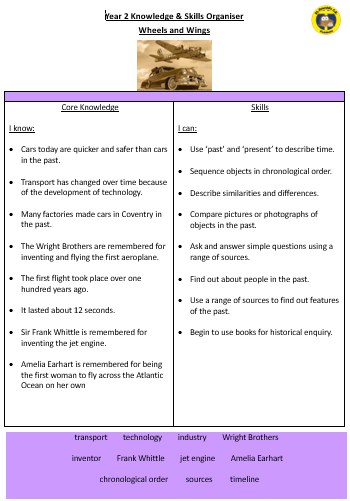
Wheels and Wings is our topic for this term.

In History, the children will be taught about:
-
The past, using common words and phrases relating to the passing of time.
-
The ways in which we can find out about the past and different ways in which it is represented.
-
Events beyond living memory that are significant nationally or globally – The first aeroplane flight.
-
Significant individuals in the past who have contributed to national and international achievements – The Wright Brothers, Amelia Earhart, Sir Frank Whittle.
- Significant historical people / places in their own locality – Sir Frank Whittle, Coventry car industry.
SCIENCE
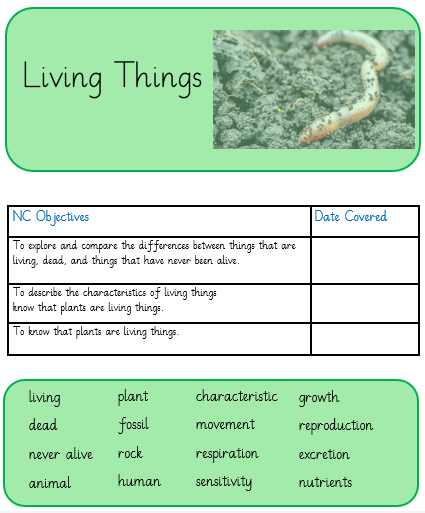
The unit we will cover this term is Living Things.

The children will:
- explore and compare the differences between things that are living, dead, and things that have never been alive.
- describe the characteristics of living things.
- know that plants are living things.
RE
This term, children will be focusing on Islamic world views and how beliefs are shared and celebrated.

The children will get the opportunity to discuss the similarities and differences between different religions and how beliefs are celebrated in different ways.
PSHE
This term, children will be focusing on 'Being Me in My World'.

These lessons focus on hopes, fears, rights, responsibilities, choices, and belonging. The children will get the opportunity to share their thoughts and opinions and listen to each other's ideas.
ART & DESIGN
This term, children will collage different transport from the past in the style of artist, Hannah Hoch.
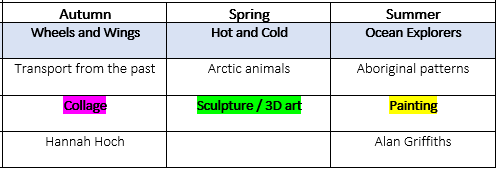
The children will research Hannah Hoch's artwork and then design and collage their own unique pieces of work.
DESIGN & TECHNOLOGY
This term, children will design and make a moving picture using levers and sliders.
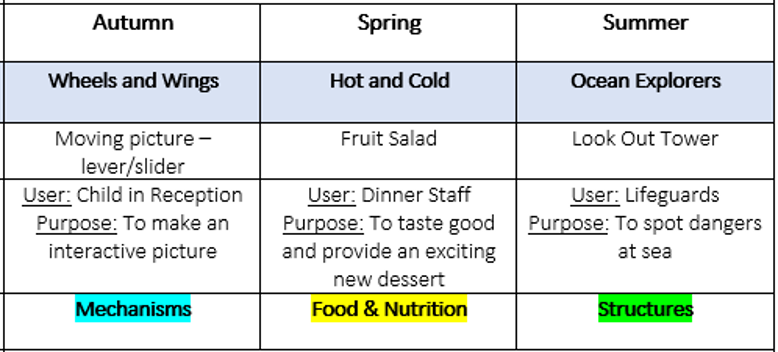
The children will investigate how levers and sliders work and then design, make and evaluate their own moving picture, thinking carefully about the user and purpose of their product.
Autumn highlights